
中山大學社會學研究所南方社會議題:The Ocean at Work: Migrant Labor and Oceanic Globalization (9/23)
2026-09-15
演講人:Beatrice Zani (法國國家科學研究中心 副研究員)
題目:The Ocean at Work: Migrant Labor and Oceanic Globalization
時間:2026年9月23日 下午1點半到3點半
地點:社科院3004-2
演講簡介:
Global seafood markets rely on forms of labor that remain largely invisible to consumers.This talk explores the working lives of Southeast Asian migrant fishers employed aboard Taiwan’s distant-water fishing vessels, and the maritime worlds through which their labor is organized. It draws on more than four years of multi-sited ethnographic research in Taiwan, Indonesia, and Singapore, combining participant observation with more than 140 interviews with migrant fishers, vessel owners, labor brokers, port authorities, NGOs, and trade unionists.
The talk takes the ocean seriously as a site of labor rather than simply as the setting in which work takes place. Life aboard fishing vessels is shaped by shifting jurisdictions, fragmented forms of authority, and uneven access to protection and accountability. These conditions also connect the vessel to recruitment sites, ports, and workers’ home communities, shaping how migrants move, work, wait, and maintain relationships across maritime and terrestrial spaces.I use these ethnographic materials to develop the notion of an oceanic labor regime. This perspective shows how the specific spatial and legal conditions of the sea become part of the organization of migrant labor itself. It also offers a different way of thinking about globalization, one that starts from maritime space and follows the movements of workers, commodities, and power across the ocean. Looking at the seafood economy from the sea makes visible forms of labor and inequality that are difficult to see from the shore.
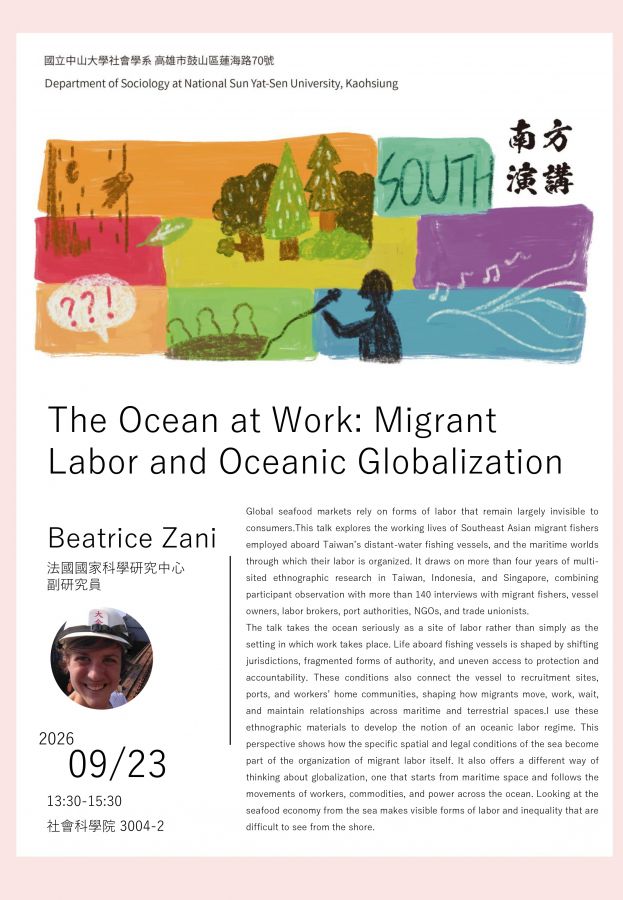
題目:The Ocean at Work: Migrant Labor and Oceanic Globalization
時間:2026年9月23日 下午1點半到3點半
地點:社科院3004-2
演講簡介:
Global seafood markets rely on forms of labor that remain largely invisible to consumers.This talk explores the working lives of Southeast Asian migrant fishers employed aboard Taiwan’s distant-water fishing vessels, and the maritime worlds through which their labor is organized. It draws on more than four years of multi-sited ethnographic research in Taiwan, Indonesia, and Singapore, combining participant observation with more than 140 interviews with migrant fishers, vessel owners, labor brokers, port authorities, NGOs, and trade unionists.
The talk takes the ocean seriously as a site of labor rather than simply as the setting in which work takes place. Life aboard fishing vessels is shaped by shifting jurisdictions, fragmented forms of authority, and uneven access to protection and accountability. These conditions also connect the vessel to recruitment sites, ports, and workers’ home communities, shaping how migrants move, work, wait, and maintain relationships across maritime and terrestrial spaces.I use these ethnographic materials to develop the notion of an oceanic labor regime. This perspective shows how the specific spatial and legal conditions of the sea become part of the organization of migrant labor itself. It also offers a different way of thinking about globalization, one that starts from maritime space and follows the movements of workers, commodities, and power across the ocean. Looking at the seafood economy from the sea makes visible forms of labor and inequality that are difficult to see from the shore.