
中研院社會所 潘欣欣副研究員 專題演講|人口特徵與抗敵意志:台日韓的世界價值觀調查證據(6/26)
2026-06-23
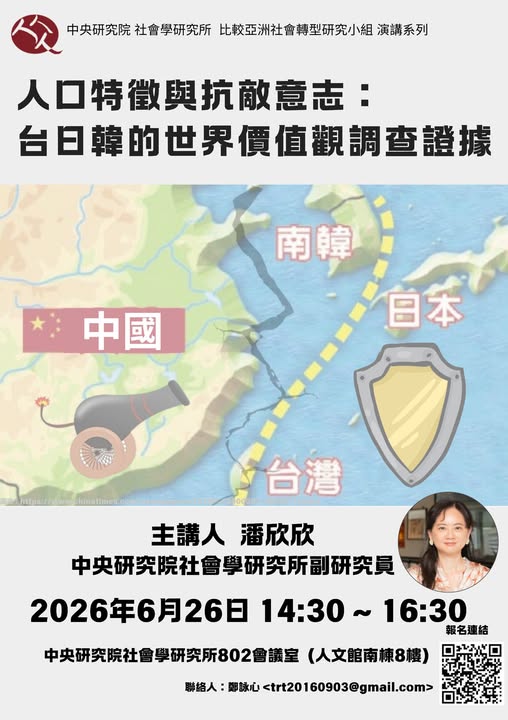
【專題演講|人口特徵與抗敵意志:台日韓的世界價值觀調查證據】
當一個社會愈來愈老、孩子愈來愈少,人們是否還願意為國家而戰?
台灣、日本與韓國同處東北亞地緣政治前線,也共同面臨少子化、高齡化與婚育率下降的人口挑戰。本次演講將運用世界價值觀調查跨國資料,探討年齡、性別、婚姻與子女狀況如何影響民眾抵禦外來威脅的意願,並檢驗多種社會學理論。當人口結構持續轉型,社會的集體動員能力與戰鬥意志將如何改變?歡迎一起深入思考國家安全背後的人口與社會問題。
-------------------------------------------
【講題】人口特徵與抗敵意志:台日韓的世界價值觀調查證據
【講者】潘欣欣(中央研究院社會學研究所副研究員)
【主持】彭保羅(中研院社會所副研究員、本所比較亞洲社會轉型主題研究小組召集人)
【時間】2026.06.26(五)14:30 - 16:30(14:00 開始報到)
【地點】中央研究院社會學研究所 802 會議室(人文社會科學館南棟 8 樓)
【活動聯絡】助理 鄭詠心(trt20160903@gmail.com)
【演講簡介】
戰爭會造成傷亡,社會的人口結構,可能深刻影響民眾是否願意為國家拿起武器抵禦外來侵略。台日韓同處東北亞地緣政治前線,面對共同安全威脅,三個社會也同樣正在經歷老齡化 、少子化與婚育率下滑的人口結構變遷,集體的戰鬥意志是否也會跟著改變?此次演講探討年齡、性別、婚姻與子女狀況,如何影響民眾為國而戰的意願,並以世界價值觀調查的跨國資料加以實證檢驗。講者提出四組競爭性的理論解釋。年長者是否因體能與生命處境的改變而趨於迴避戰鬥?性別社會化的規範是否持續驅動男性展現更強的作戰意志?單身者因缺乏家庭牽絆,是否反而更無所畏懼?為人父母的責任感,究竟是激發保護欲,還是強化了對戰爭的抗拒?這些問題指向一個更根本的社會學關懷:當人口結構持續轉型,一個社會動員自身、抵禦外部威脅的集體能力,將如何隨之重構?
【講者簡介】潘欣欣,中央研究院社會學研究所副研究員,東吳大學社會學系兼任副教授。研究興趣橫跨社會學與政治學。主要使用民意調查作為研究方法。研究對象以台灣、中國及東亞社會為主。
【主持人簡介】彭保羅為日本慶應大學碩士、法國高等社會科學研究院博士。最近的著作有與汪宏倫、Olga Kutsenko 合編 War frames: Insights from Eastern Europe and East Asia,登刊於英國期刊The Sociological Review。
Topic: Demographic Determinants of Willingness to Fight: Evidence from World Values Surveys in Japan, South Korea, and Taiwan
Speaker: Hsin-Hsin PAN ( Associate Research Fellow, Institute of Sociology, Academia Sinica )
Host: Paul Jobin (Associate Research Fellow, coordinator of the research team on Asian Social Transformation in Comparative Perspective, Institute of Sociology, Academia Sinica)
Time: 2026.06.26 (Fri.) 14:30 - 16:30(14:00 sign in)
Registration: https://forms.gle/m3gXS7RcV1aAE7VG6
Venue: 8F, Room 802, Institute of Sociology, South Wing, Humanities and Social Sciences Building, Academia Sinica
Contact Person: Anita Cheng (IOS Asia TRT Assistant) <trt20160903@gmail.com>
Brief
War causes casualties, and a society’s demographic structure may profoundly influence whether its citizens are willing to take up arms to defend their country against foreign aggression. Taiwan, Japan, and South Korea are all situated on the front lines of Northeast Asian geopolitics and face common security threats. At the same time, all three societies are experiencing demographic changes characterized by population aging, declining birth rates, and falling rates of marriage and childbearing. Will their collective will to fight also change accordingly?
This lecture explores how age, gender, marital status, and whether one has children influence people’s willingness to fight for their country, drawing on cross-national data from the World Values Survey for empirical examination. The speaker presents four competing theoretical explanations. Do older individuals become more reluctant to fight because of changes in physical capability and life circumstances? Do gender socialization norms continue to drive men to exhibit a stronger willingness to fight? Are single individuals, lacking family ties, more fearless in the face of conflict? Does the sense of responsibility associated with parenthood inspire protective instincts, or does it instead strengthen resistance to war?
These questions point to a more fundamental sociological concern: as demographic structures continue to transform, how will a society’s collective capacity to mobilize itself and defend against external threats be reconstructed?
About the speaker:
Hsin-Hsin PAN Associate Research Fellow, Institute of Sociology, Academia Sinica; Adjunct Associate Professor, Department of Sociology, Soochow University. Interests: Political Sociology, War Psychology, Survey Experimental Methods for Sensitive Questions, Social Foundation for Political Transformation in Contemporary China.
About the chair:
Paul Jobin received his PhD from Ecole des Hautes Etudes en Sciences Sociales (EHESS), Paris. Among his recent publications is a collective volume co-edited with Horng-luen Wang and Olga Kutsenko "War frames: Insights from Eastern Europe and East Asia" (The Sociological Review).
本次演講僅限現場參與形式,歡迎到場聆聽