
臺大傳統與科學形上學研究中心演講《Patient Models in Care: Ethnographic Insights into the Operativity of the Biopsycho
2026-05-27
主講人: 嚴如玉教授(陽明交通大學心智哲學研究所)
時間: 2026年6月1日(週一)下午15:30~17:30
地點: 台灣大學人文館345室
Patient Models in Care: Ethnographic Insights into the Operativity of the Biopsychosocial Model
Karen Yan, Min-Jung Cheng, Yun-Ying Kuo, Yong Alison Wang
Abstract
The biopsychosocial model (BPSM) has long been presented as a framework for holistic medicine and is often discussed in relation to patient-centered approaches to care. However, whether its tripartite categories function as operative structures of clinical reasoning in practice remains an open question. This qualitative study examined how clinical reasoning was organized in a specialized cancer hospital in Taiwan between January 2022 and December 2023. The research involved 153.5 hours of ethnographic fieldwork, including 50.5 hours of exploratory immersion across multiple clinical settings and 103 hours of focused team-based observation in oncology, colorectal surgery, and palliative care outpatient clinics. In addition, 17 semi-structured interviews were conducted with nine healthcare professionals (including three physicians and six other clinical staff) and eight patients. We analyzed how salience and relevance were structured within and across clinical specialties.
Rather than observing reasoning organized through explicit integration of biological, psychological, and social domains, we found that each specialty relied on distinct tool repertoires that configured patienthood in patterned ways. Oncology consultations were structured around staging systems and expectation management; surgical encounters were organized through anatomical visualization and probabilistic risk framing; and palliative care centered symptom scales, narrative recapping, and informational clarification. These patterns did not reflect simple neglect of psychosocial dimensions but revealed alternative institutional logics of reasoning shaped by specialty-specific tools.
We argue that the relationship between the BPSM’s conceptual schema and clinical practice is contingent on institutional infrastructures. Plurality in patient-centered care may therefore arise from tool-mediated configurations of patienthood rather than from incomplete integration of predefined domains. By combining ethnographic analysis with philosophical reflection, this study contributes a practice-sensitive account of how clinical reasoning is structured in specialized healthcare settings.
國立台灣大學哲學系
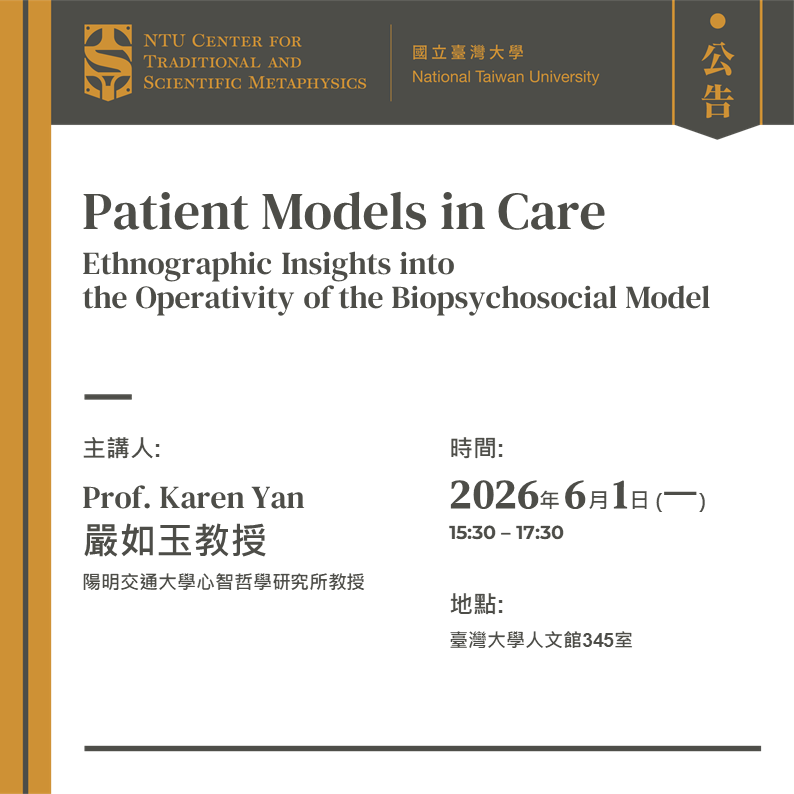
時間: 2026年6月1日(週一)下午15:30~17:30
地點: 台灣大學人文館345室
Patient Models in Care: Ethnographic Insights into the Operativity of the Biopsychosocial Model
Karen Yan, Min-Jung Cheng, Yun-Ying Kuo, Yong Alison Wang
Abstract
The biopsychosocial model (BPSM) has long been presented as a framework for holistic medicine and is often discussed in relation to patient-centered approaches to care. However, whether its tripartite categories function as operative structures of clinical reasoning in practice remains an open question. This qualitative study examined how clinical reasoning was organized in a specialized cancer hospital in Taiwan between January 2022 and December 2023. The research involved 153.5 hours of ethnographic fieldwork, including 50.5 hours of exploratory immersion across multiple clinical settings and 103 hours of focused team-based observation in oncology, colorectal surgery, and palliative care outpatient clinics. In addition, 17 semi-structured interviews were conducted with nine healthcare professionals (including three physicians and six other clinical staff) and eight patients. We analyzed how salience and relevance were structured within and across clinical specialties.
Rather than observing reasoning organized through explicit integration of biological, psychological, and social domains, we found that each specialty relied on distinct tool repertoires that configured patienthood in patterned ways. Oncology consultations were structured around staging systems and expectation management; surgical encounters were organized through anatomical visualization and probabilistic risk framing; and palliative care centered symptom scales, narrative recapping, and informational clarification. These patterns did not reflect simple neglect of psychosocial dimensions but revealed alternative institutional logics of reasoning shaped by specialty-specific tools.
We argue that the relationship between the BPSM’s conceptual schema and clinical practice is contingent on institutional infrastructures. Plurality in patient-centered care may therefore arise from tool-mediated configurations of patienthood rather than from incomplete integration of predefined domains. By combining ethnographic analysis with philosophical reflection, this study contributes a practice-sensitive account of how clinical reasoning is structured in specialized healthcare settings.
國立台灣大學哲學系