
中研院亞太區域研究專題中心亞太新視域演講|Refugees Travailing through Asia Rohingya Narratives of their Exilic Wanderings
2026-04-20
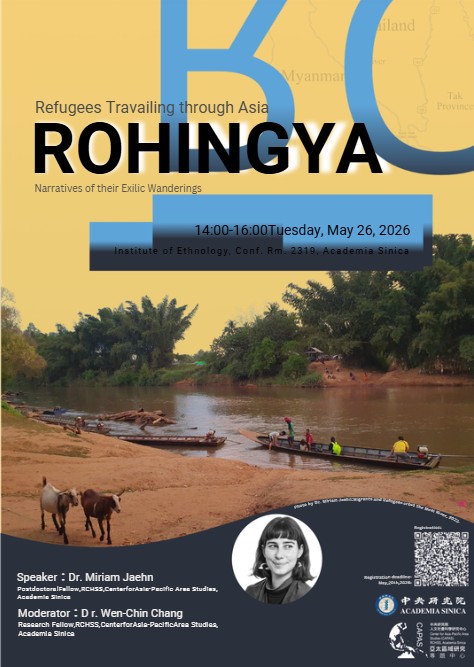
亞太新視域演講|Refugees Travailing through Asia Rohingya Narratives of their Exilic Wanderings by Dr. Miriam Jaehn
(will be conducted in English)
時間:2026年5月26日(週二)14:00-16:00 【13:30-14:00報到】
地點:中央研究院 民族學研究所 第三會議室
主辦單位:中研院人社中心亞太區域研究專題中心
報名網址:https://reurl.cc/mpR70M
報名截止:2026年5月20日(週三)中午12:00前
主講人: Dr. Miriam Jaehn 中央研究院 亞太區域研究專題中心博士後研究員
主持人:張雯勤博士 中研院亞太區域研究專題中心研究員
2026 CAPAS-Postdoctoral Fellow Speech| Dr. Miriam Jaehn
Speaker: Dr. Miriam Jaehn(Postdoctoral Fellow, CAPAS, RCHSS, Academia Sinica)
Moderator: Dr. Wen Chin Chang, Research Fellow , CAPAS, Academia Sinica
Topic: Refugees Travailing through Asia Rohingya Narratives of their Exilic Wanderings
Time: Tue. May 26, 2026 14:00-16:00【13:30-14:00 Registration】
Venue: 3rd Conference Rm, Institute of Ethnology, Academia Sinica
Registration Deadline: 12:00, Wed. May, 20 ,2026
Organizer: Center for Asia-Pacific Area Studies (CAPAS) of RCHSS, Academia Sinica
Abstract:
In 2015, the news was filled with reports on dehydrated, starving, and tortured Rohingya abandoned in the Andaman Sea and in jungle camps along the Thai-Malaysia border. They had fled persecution in Arakan, Myanmar and precarity in Cox’s Bazar, Bangladesh. It was the first time that news surrounding Rohingya’s flight across the Bay of Bengal region led to international headlines. But the violence in their homeland and their escape from it across the region had been sweltering and growing for decades. It had developed into a profitable and exploitative business. Based on ethnographic fieldwork with Rohingya in Thailand, Bangladesh and Nepal, I reconstruct Rohingya’s experiences of their exilic wanderings through their own narratives. Rohingya’s narratives are often fragmented and dispersed across a wide terrain and span years. Piecing them together through this book project, I learn to understand Rohingya journeys as a familial and communal ‘travail’ emblematic to the life of refugees and forced migrants in Asia in the late 20th and early 21st century. The term ‘travail’ denotes a mode of travel that involves hardship and work. It does not signify a mode of travel that is defined by pleasure, status, or adventure. In contrast, the term captures how Rohingya are repeatedly forced to flee due to persecution and deportation and at the same time, they are arrested in movement by encampment and detention; Rohingya have to precariously work and find themselves bonded by debt to finance their family’s survival; they tirelessly seek, work, and wait for a better life. Yet, most remain unable to escape the trauma of their ongoing genocide as the interests of competing refugee regimes and a restrictive and profit-driven migration industry do not allow them to arrive in a safe haven.
(will be conducted in English)
時間:2026年5月26日(週二)14:00-16:00 【13:30-14:00報到】
地點:中央研究院 民族學研究所 第三會議室
主辦單位:中研院人社中心亞太區域研究專題中心
報名網址:https://reurl.cc/mpR70M
報名截止:2026年5月20日(週三)中午12:00前
主講人: Dr. Miriam Jaehn 中央研究院 亞太區域研究專題中心博士後研究員
主持人:張雯勤博士 中研院亞太區域研究專題中心研究員
2026 CAPAS-Postdoctoral Fellow Speech| Dr. Miriam Jaehn
Speaker: Dr. Miriam Jaehn(Postdoctoral Fellow, CAPAS, RCHSS, Academia Sinica)
Moderator: Dr. Wen Chin Chang, Research Fellow , CAPAS, Academia Sinica
Topic: Refugees Travailing through Asia Rohingya Narratives of their Exilic Wanderings
Time: Tue. May 26, 2026 14:00-16:00【13:30-14:00 Registration】
Venue: 3rd Conference Rm, Institute of Ethnology, Academia Sinica
Registration Deadline: 12:00, Wed. May, 20 ,2026
Organizer: Center for Asia-Pacific Area Studies (CAPAS) of RCHSS, Academia Sinica
Abstract:
In 2015, the news was filled with reports on dehydrated, starving, and tortured Rohingya abandoned in the Andaman Sea and in jungle camps along the Thai-Malaysia border. They had fled persecution in Arakan, Myanmar and precarity in Cox’s Bazar, Bangladesh. It was the first time that news surrounding Rohingya’s flight across the Bay of Bengal region led to international headlines. But the violence in their homeland and their escape from it across the region had been sweltering and growing for decades. It had developed into a profitable and exploitative business. Based on ethnographic fieldwork with Rohingya in Thailand, Bangladesh and Nepal, I reconstruct Rohingya’s experiences of their exilic wanderings through their own narratives. Rohingya’s narratives are often fragmented and dispersed across a wide terrain and span years. Piecing them together through this book project, I learn to understand Rohingya journeys as a familial and communal ‘travail’ emblematic to the life of refugees and forced migrants in Asia in the late 20th and early 21st century. The term ‘travail’ denotes a mode of travel that involves hardship and work. It does not signify a mode of travel that is defined by pleasure, status, or adventure. In contrast, the term captures how Rohingya are repeatedly forced to flee due to persecution and deportation and at the same time, they are arrested in movement by encampment and detention; Rohingya have to precariously work and find themselves bonded by debt to finance their family’s survival; they tirelessly seek, work, and wait for a better life. Yet, most remain unable to escape the trauma of their ongoing genocide as the interests of competing refugee regimes and a restrictive and profit-driven migration industry do not allow them to arrive in a safe haven.